News Detail
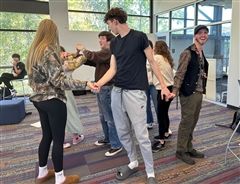
Stuco lead assembly with bonding activity: the human knot.
Upper School Community
At The New School, we are focused on developing the whole person, and that means we place a high value on creating a community where every student is valued and supported. In the Upper School, we have found innovative ways to deliver on this vision. While many schools tout their sense of community, we build community time into the schedule in meaningful ways that support our students’ social-emotional development and help them to become well-rounded, curious students.
At the heart of the Upper School’s community time is our advisory program. Twice a week, students meet in small advisory groups of 8-10 students, engaging in discussions and activities that help students and faculty build close connections. Advisors are always available to help guide students as they navigate the challenges of academic classes and school life.
Students also gather together for student-led clubs twice a week, which offer a chance to play, serve, and explore. Clubs include student government, disc golf club, quiz bowl, Lego design, and many others. And once a week, all Upper School students and faculty gather together for assembly, where students hear from voices both in the school community and from the wider community outside of school.
In addition, the Upper School has also innovated what we call our Seminar Program, in which students and faculty meet once per week in grade-level groups to discuss a variety of social-emotional topics. Students cycle through five-week rotations throughout the year that address various wellness topics, technology usage, and college and career counseling.
The College and Career Counseling program is especially dear to me, as I’ve served as Director of College Counseling for the past two years and have reframed the program to ensure that all Upper School students in grades 8-12 engage in imagining a life beyond TNS. For younger students, that work focuses on identifying interests and skills they can develop in their high school classes and through extracurricular experiences. For older students, that means learning about different career paths, researching colleges and post-graduate programs, hearing from college admissions representatives visiting campus, and completing applications and essays.
Ultimately, we want our students to develop the skills and confidence necessary to succeed in life when they leave our campus. And while that includes traditional academic skills like reading, writing, and problem-solving, it also includes the ability to build positive relationships, make healthy choices, contribute to a successful team, engage in self-reflection, and, above all, lead a life of purpose. That’s whole person education, and at TNS, that education starts with a commitment to community time.